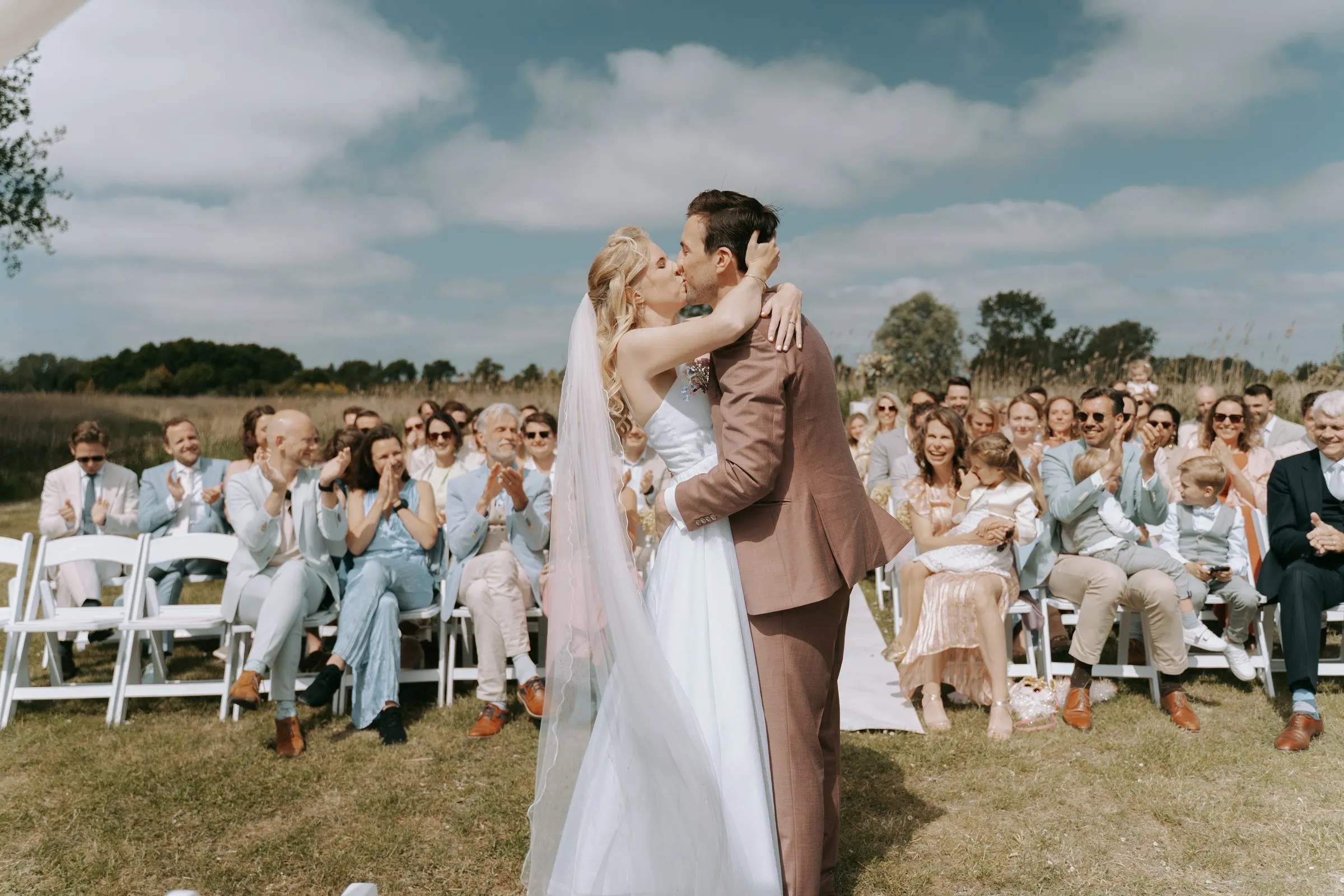
Greece is one of the most popular places in Europe for a destination wedding, and it’s easy to see why: islands, sea, warm evenings, good food and a culture that knows how to celebrate. I’m Kate Lang, a wedding photographer based in Athens. This guide walks through the big decisions in the order you’ll usually face them.
Please note: legal requirements depend on your nationality and the municipality where you marry, and they change. Use this guide as an overview, and always confirm the current rules with your embassy, the local municipality (dimos) in Greece, or your wedding planner.
1. Legal, religious or symbolic?
This is the first question, because it affects paperwork, timing and where the ceremony can take place.
Civil ceremony
A civil wedding in Greece is legally binding. It’s performed by the mayor or a representative of the municipality, often at the town hall, though some municipalities allow other approved locations. The ceremony is in Greek, so you may need a translator.
Religious ceremony
A Greek Orthodox wedding in a church is the most traditional option. It has its own requirements from the church, including documents about baptism, and a religious wedding between a Christian and a non-Christian isn’t possible in the Orthodox Church — in that case a civil ceremony is the legal route. Other denominations have their own churches and rules in some parts of Greece.
Symbolic ceremony
Many international couples marry legally at home and hold a symbolic ceremony in Greece. It has no legal force, but you can have it almost anywhere — a cliff terrace, a beach, a villa garden — with any words and any officiant you like. It’s the simplest option, and the one that gives you the most freedom.
2. The paperwork, in general terms
For a legal wedding in Greece, couples typically need to:
- apply to the municipality where the ceremony will take place for a marriage licence;
- provide passports and birth certificates;
- provide a certificate of no impediment (or a similar document from your country proving you’re free to marry);
- have foreign documents legalised with an apostille and officially translated into Greek;
- bring two witnesses with ID to a civil ceremony;
- register the marriage at the local registry office after the ceremony — this has to be done within a fixed deadline (commonly cited as 40 days), so don’t leave it.
Exact documents, fees and timelines differ by country and municipality, which is why many couples let a local planner or a specialised agency handle this part.
Since 2024, civil marriage in Greece is open to same-sex couples as well.
3. When to get married
The main wedding season is May to October.
- May, June, September and October — warm, softer light, fewer crowds, and usually calmer wind.
- July and August — hot, very busy on the islands, with the meltemi wind blowing strongly on the Cyclades. Plan for wind with your decor, hair and veil.
Whatever the month, the late afternoon and the hour before sunset give the best light for photos. Midday summer sun is harsh, so most ceremonies are scheduled later in the day.
4. Choosing a place
- Santorini — the caldera and sunsets; popular and busy, venues book early. Santorini wedding venues
- Mykonos — beaches, villas and parties. Mykonos wedding venues
- Athens and the Riviera — easy logistics, no ferries, city and seaside venues. Athens wedding venues
- Crete — big, varied and well connected. Crete wedding venues
- Paros and smaller islands — relaxed and Cycladic. Paros wedding venues
The full overview is in my Greece wedding venues guide.
5. A planner or do it yourself?
For a destination wedding, a local planner saves a lot of stress: they know the venues and suppliers, speak Greek, handle permits and paperwork, and are there on the day. For a small symbolic ceremony at a villa, you can keep things simple without one. Read more about what wedding packages in Greece usually include and how much a wedding in Greece costs.
6. Your guests
- Send save-the-dates early — guests need time to book flights and accommodation, especially in summer.
- Think about how guests will get to the island: flights to Athens, then a connecting flight or ferry.
- A welcome drink the evening before and a relaxed day after are common, and make the trip worthwhile for everyone.
7. A rough timeline
- 12+ months before: choose the type of ceremony, region and date; book venue and planner.
- 9–12 months: book photographer and other key suppliers; send save-the-dates.
- 6 months: start the legal paperwork if you’re marrying legally in Greece.
- 3 months: finalise the timeline, guest logistics and the photo plan.
- After the wedding: register the marriage within the deadline if it’s a legal ceremony.
Photographing your wedding in Greece
I’m based in Athens and photograph weddings across Greece in an editorial, documentary style. Packages start from €600 for four hours, with full-day coverage up to twelve hours from €1,500; travel to the islands is agreed in advance. See my pricing, or the pages for elopements and Santorini weddings.
Tell me about your plans through the contact page — I’m happy to help you think through timing and light for your day.